Between science and poetry, discover how drawing inspiration from the living world re-enchants the ways we build, grow, and live.
In an era marked by parched summers and torrential rains, one thing becomes clear: our answers are often right in front of us. More and more researchers and craftspeople are turning to bio-inspiration to imagine projects that meet today’s challenges.
Life on Earth is nothing new: with 3.8 billion years on the clock, nature has had time to refine remarkably efficient models. Observing the ecosystems around us is like opening a book of know-how, where each page tells the story of a simple, ingenious way of working.
This mindset—known as biomimicry or bio-inspiration—is not a fad: it’s an invitation to reconcile progress with the Earth.
To understand this philosophy, imagine a woodland floor after the rain: water trickles gently, soaks in, disappears beneath the moss, then reappears farther on. Forests, wetlands, and soils know how to capture carbon, filter water, and recycle nutrients.
By observing these biological systems, engineers discover solutions capable of addressing our sustainability challenges. This is how technologies inspired by the living world are born: they recycle water, regulate temperature, produce clean energy, and make the most of every drop.
On this journey, we’ll set out to discover landscapes and inventions that embody this alliance between science and nature. And we’ll see how Groupe O and its brands InphytO®, Infinit’O™ and O bioPool turn water into a virtuous cycle through bioengineering.
We’ll also look at iconic inventions—from Velcro to surgical glues—and the horizons this approach opens up in terms of growth, resource management, and well-being. Let yourself be guided: each section invites you to dream as much as it helps you understand.
Understanding biomimicry: imitating life without betraying it
The word “biomimicry” blends the Greek bios (“life”) and mimesis (“imitation”). Behind this etymology lies a discipline that learns from plants, animals, and microorganisms in order to invent differently.
Far from merely copying shapes, biomimicry seeks to understand how living systems use matter and energy.
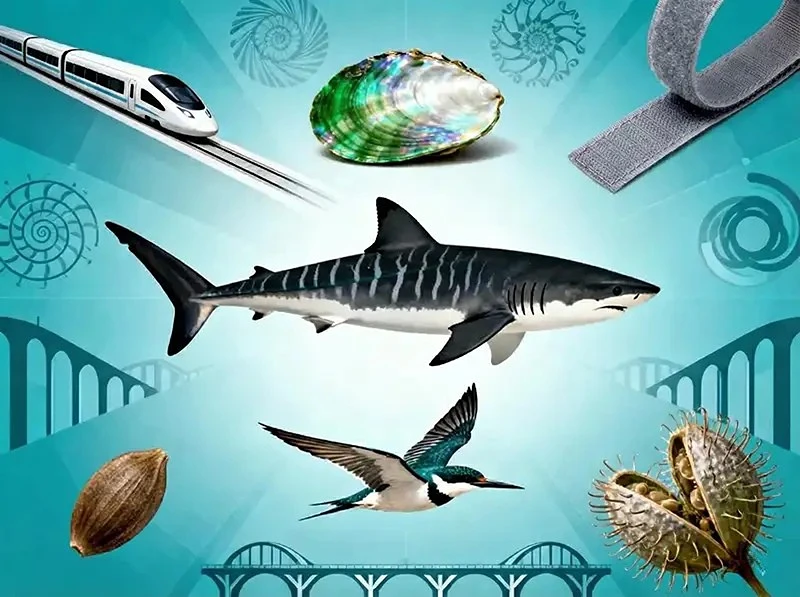
A mussel shell combines strength and lightness; shark skin reduces drag; the kingfisher’s flight inspired trains designed to break the sound barrier in silence. Every observed function is a lesson in frugality that bioengineering translates into tangible innovations.
In France, this way of drawing inspiration from the living world is progressing rapidly. Institutions such as France Stratégie, along with universities and entire regions, are dedicating programs to it. The Nouvelle-Aquitaine region brings together several hundred players—labs, start-ups, craftspeople, and local authorities—exploring this path. They all share the belief that a more sustainable world will emerge by translating nature’s models into our professions. This approach is interdisciplinary: biologists, architects, engineers, and sociologists combine their talents to imagine products and services that respect biodiversity.
Let’s illustrate this approach with a few stories.
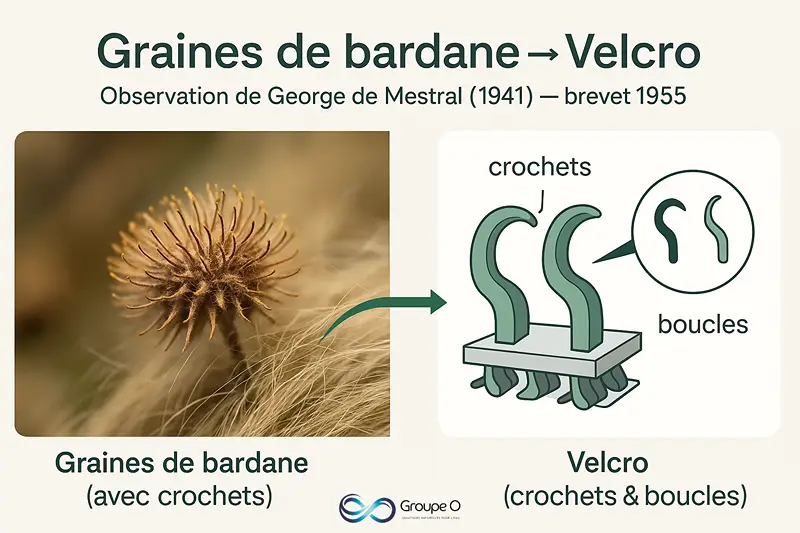
Along mountain trails, burdock seeds cling to animal fur. Intrigued by these sticky “burrs,” Swiss engineer Georges de Mestral studied them under a microscope. From those tiny hooks came the famous Velcro, a fastening system made of loops and hooks that can hold several dozen kilos. Used everywhere from shoes to aerospace, this invention shows how a simple idea can become a global success.
In a different register, marine worms secrete an extraordinary glue to attach their tubes to rocks. By observing this phenomenon, the company Tissium developed a biodegradable surgical adhesive that seals tissues without stitches.
Biomimicry thus reveals unexpected opportunities for health and industry.
An example: the Nouvelle-Aquitaine region, a territory that listens to its landscapes
Nestled between the ocean and the mountains, Nouvelle-Aquitaine is a haven of biodiversity. Its dunes, forests, and wetlands shelter a mosaic of organisms and habitats.
For about ten years, the region has bet on biomimetic innovation. The Regional Development and Innovation Agency supports collectives in the implementation of nature-inspired projects:
- roofs that “perspire” like leaves,
- flexible materials inspired by fish,
- greenhouses that mimic termite mounds.
This approach is a real lever for the local economy, attracting talent and funding.
The sea plays a central role. In ports and laboratories, researchers observe fins, algae, and shells to imagine gentler technologies.
Turbines inspired by whale flippers gain performance; boats are coated with finishes that reduce drag by mimicking shark skin.
Local businesses draw on this bio-inspiration to design products that respect the marine environment.
That’s how an entire region becomes an open-air laboratory.
Nouvelle-Aquitaine doesn’t forget fields and cities: educational programs raise awareness among high-school students, university students, and farmers about bio-inspiration.
In rural communities, public buildings experiment with green roofs inspired by clay cliffs, while farms test passive greenhouses that naturally regulate temperature.
The 400 stakeholders engaged in this dynamic share their ideas through trade shows, videos, and annual gatherings. Together, they show that a territory can reinvent itself by observing its own strengths.
Finally, the region is part of a broader strategy, led by the French government and institutes such as France Stratégie, to make France a leader in bioengineering.
By cultivating its biological wealth and turning it into respectful innovations, it opens new prospects for jobs, research, and quality of life. Each supported project demonstrates that it is possible to reconcile development with the protection of the living world.
Groupe O: a symphony of water and biodiversity
At the heart of this momentum in France, with many partners in Nouvelle-Aquitaine and across the country, Groupe O embodies innovation applied to water and habitat.
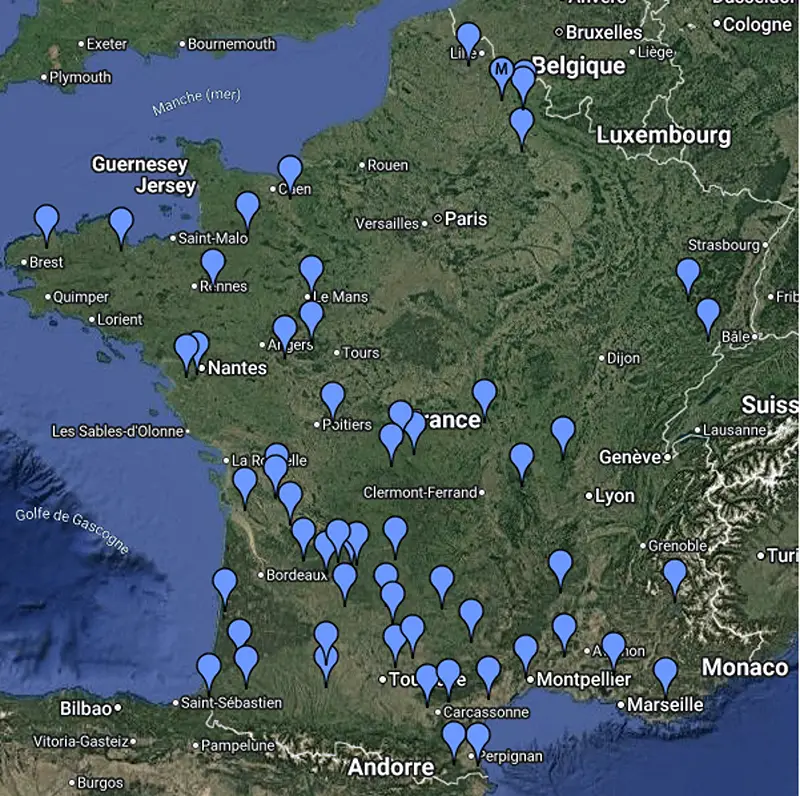
Our company, headquartered in Caudry (Hauts-de-France) with an office in Aix-en-Provence, brings together three complementary brands—InphytO®, Infinit’O™ and O bioPool—that replicate natural water cycles for our homes and gardens.
Our vision: observe how a wetland filters and regenerates water, how a forest retains nutrients, and translate those mechanisms into installations accessible to everyone.
The result: a circular model in which water is collected, regenerated, used, then returned to the soil—while enriching it.
By combining the expertise of these three entities, the group creates a coherent system.
Wastewater flows through InphytO®, is stored and redistributed thanks to Infinit’O™, and provides moments of relaxation through O bioPool.
Each of these offerings is inspired by a specific ecosystem and delivers services suited to domestic or collective uses.
Together, they provide a powerful lever to turn water management into harmonious development.
InphytO®: constructed wetlands as a way of life
InphytO® reimagines constructed wetland wastewater treatment by immersing itself in the wetland model. Wastewater passes through planted filters of emergent wetland plants and reed beds, where invisible bacteria break down organic matter. Mineral substrates promote flow and oxygenation, while plants absorb nutrients and pollutants. The result is clear water that can irrigate the vegetable garden or gently infiltrate into the ground. These filtering gardens create cool microclimates, attract butterflies and birds, and turn a technical process into a sensory stroll.
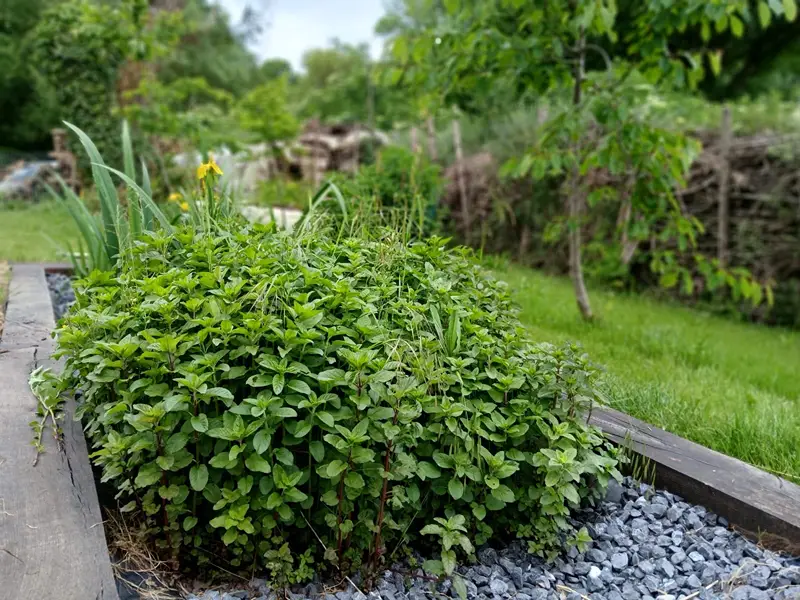
Beyond beauty, InphytO® offers a practical response to health requirements: its installations operate without chemicals, comply with standards, and deliver a return on investment through water savings.
They suit homeowners, eco-villages, campsites, and any organization that wants to combine performance with respect for the living world. In this way, implementing these basins becomes an opportunity to start a new relationship with one’s garden.
Discover InphytO® constructed wetland treatment
Infinit’O™: a domestic cycle that embraces rainfall
Infinit’O™ draws inspiration from the water cycle to equip homes and buildings.
The system captures rainwater via roofs or catchment basins, regenerates it using biomimetic principles, then stores it in connected tanks.
This regenerated water then supplies toilets, the washing machine, or irrigation—reducing the consumption of drinking water.
Infinit’O™ is managed by sensors that measure reserve levels and adjust distribution based on weather and usage.
Residents access a simple interface that teaches them to manage water the way you manage a vegetable garden: with attention and pleasure.
This system goes beyond the individual scale. In a neighborhood, schools or businesses can pool tanks and natural filters. Infinit’O™ then becomes a shared solution, part of a sustainable territory development approach.
Building professionals see in this innovation a way to design regenerative habitats that actively contribute to managing water resources.
See how Infinit’O™ makes rainwater valuable
O bioPool: swimming that respects water
O bioPool turns the pool into a living ecosystem. Water circulates between a swimming basin and a planted filtration basin. Mineral substrates, micro-organisms, and plants provide biofiltration, reproducing what happens in a river. The result is soft water—without chlorine or salt—pleasant on the skin and odor-free. Smart controls maintain balance, and maintenance comes down to a few gardening gestures. Overflow water irrigates planting beds, then returns to the groundwater, nourishing the garden while staying pure.
O bioPool systems can be paired with rainwater harvesting and solar panels. They adapt to the size of each plot and blend into the landscape thanks to clean lines and durable materials. This approach shows that a pool can become an ecosystem service, beneficial for well-being and the environment. It beautifully illustrates how a company can combine pleasure with respect for the living world.
Through these three brands, Groupe O shows that biomimicry is a powerful tool for innovation. Its products and services meet the expectations of citizens who want to consume less, live better, and honor nature.
The success of these offerings proves that it is possible to draw inspiration from the living world to improve daily life without giving up modernity.
Learn more about O bioPool natural pools
Outlook and challenges: cultivating the mindset of the living world
The expansion of biomimicry raises fascinating questions.
To imagine tomorrow’s innovations, we must train generations of engineers, designers, and landscape architects to observe the living world.
In schools and universities, modules dedicated to bioengineering are emerging. Students learn to read a landscape, decode organisms, and translate nature’s principles into projects. This movement takes time, resources, and support for these ideas to become reality.
Research plays a central role. Laboratories and companies must collaborate to explore materials, textures, and the extraordinary properties of life.
That requires sharing resources and funding prototypes.
Conferences organized by institutions such as France Stratégie, or by regional agencies, create spaces for exchange.
Researchers present their work there, and industrial players identify avenues for future products.
On the regulatory front, living-inspired innovations must evolve within a clear framework. Labels are emerging to guarantee the safety and performance of biomimetic solutions.
Public authorities, in dialogue with associations and businesses, are developing rules to protect habitats and data derived from the living world. The challenge is to encourage creativity while ensuring the preservation of ecosystems.
On the market side, bio-inspiration is a tremendous lever for growth.
Consumers are looking for products that embody values of frugality, quality, and aesthetics.
Companies that adopt these models strengthen their image, diversify their offerings, and open new prospects for export. They show that performance can rhyme with frugality.
Biomimicry offers a vision of growth that puts humans back in their place within nature.
Finally, this approach reminds us that biodiversity is our best ally.
Protecting forests, coral reefs, and grasslands means preserving a heritage of freely accessible knowledge.
Natural evolution provides a guiding thread: it shows that resilient systems are those that favor diversity and frugality.
By placing these lessons at the heart of our organizations and policies, we turn every crisis into an opportunity for progress.
Ready to move from inspiration to action?
Conclusion: toward a new alliance
Biomimicry is no longer a scientific curiosity: it is becoming a way of being in the world.
By diving into 3.8 billion years of evolution, we uncover treasures of ingenuity that nourish our era.
Examples like Velcro or glues inspired by marine worms show that the intuition born from a walk in the forest can change the face of an industry.
Groupe O has made this a guiding thread for its development. Its constructed wetland wastewater treatment solutions, its domestic water cycles, and its natural swimming experiences show that bio-inspiration is already firmly rooted in our gardens.
Choosing to draw inspiration from the living world is deciding to make modernity and humility go hand in hand.
It is recognizing that nature is not a deposit to be exploited, but a partner to be honored. By integrating these principles into our homes, businesses, and policies, we take part in a profound transformation that blends science, imagination, and respect.
May we continue to observe the flight of a kingfisher, a dewdrop, or a swaying alga—and draw from it the inspiration to build a gentler, more resilient world.